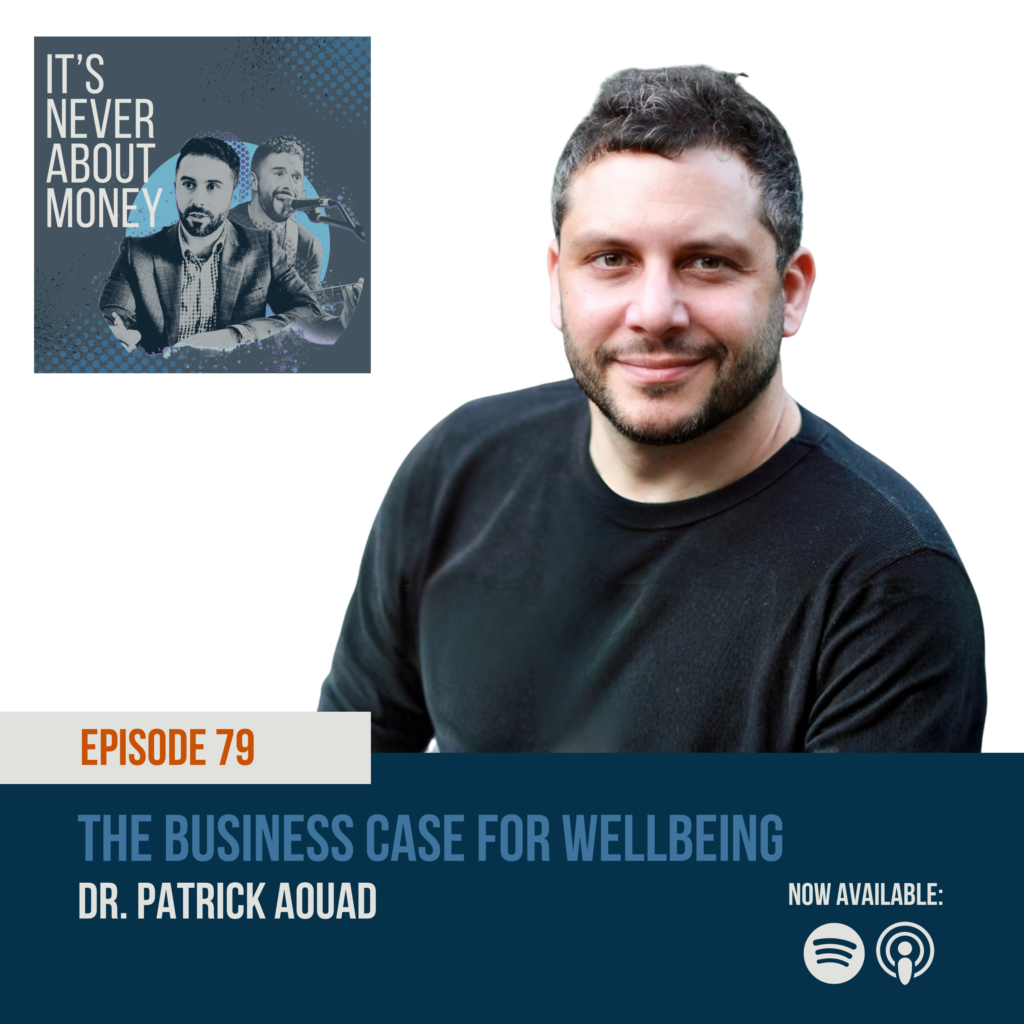
What if the most powerful competitive advantage a company could have wasn’t technology, strategy or capital – but healthy people?
That’s the question at the heart of my conversation with Dr Patrick Aouad, neurologist and Founder and CEO of CU Health, on Episode 79 of It’s Never About Money.
Patrick has spent his career at the intersection of neuroscience, medicine and business. As a specialist neurologist, he has worked with patients facing complex conditions including stroke, epilepsy, Parkinson’s disease and multiple sclerosis. In those clinical settings, he saw something fundamental: health shapes everything about how a person lives and works.
But over time, he began to look at the bigger picture.
If most people spend the majority of their waking lives at work, why aren’t workplaces a central part of how we deliver proactive healthcare?
That question eventually led him to build CU Health – a digital-first health platform designed specifically for the workplace.
Moving beyond reactive healthcare
Much of modern healthcare is reactive. People seek help once a problem has already become serious: burnout, chronic illness, anxiety, heart disease.
But Patrick believes there’s a far more effective approach – prevention.
Rather than waiting until someone becomes unwell, the goal is to create systems that support people to stay healthy in the first place.
Through CU Health, employees can access an integrated team of health professionals including GPs, psychologists, dietitians, health coaches and executive performance coaches.
The platform operates as what Patrick describes as “a clinic in the cloud”, bringing different forms of expertise together into one connected system – making high-quality care easy to access before small problems become big ones.
The hidden economic cost of poor health
One of the most interesting parts of our conversation was the business case for employee wellbeing.
Poor health doesn’t just affect individuals – it affects organisations in ways that are often invisible.
Patrick describes it as a kind of silent tax on productivity, and it shows up in many forms: burnout, disengagement, preventable sick days, higher attrition and the loss of experienced staff. When employees feel unsupported, they leave – and the cost of recruitment, training and lost intellectual capital can be enormous. But even when people stay, poor health often means they’re operating well below their potential.
On the other hand, when wellbeing is supported, the opposite happens: teams perform better, employees stay longer, and organisations benefit from stronger engagement and higher discretionary effort.
In other words, investing in health isn’t simply a wellbeing initiative – it’s a performance strategy.
Why personal responsibility isn’t enough
Individual habits matter: sleep, exercise and diet remain the foundations of good health. Patrick emphasises that prioritising these basics – getting enough sleep, moving your body and eating well – is critical for brain function, mood and long-term disease prevention.
But he also pushes back against the idea that people should simply “try harder”.
As Patrick points out, even highly disciplined people often need support at different phases of their lives. Knowing what to do is one thing – but having the structure, guidance and accountability to follow through is another.
The future of work and wellbeing
Employers already invest heavily in infrastructure, technology and strategy to improve performance. Yet the most important asset in any organisation – the people – is often left largely unsupported when it comes to health.
Rather than seeing healthcare access as a social responsibility or a cost, Patrick argues that organisations should see it as a strategic advantage – one that’s even more powerful than AI when it comes to the future of work.
In a knowledge economy where intellectual performance matters more than ever, that support can make a real difference. Because in the end, the health of a business is closely tied to the health of the people inside it.
Hear the full conversation with Dr Patrick Aouad in Episode 79 of It’s Never About Money.